
Built to Last by James C. Collins and Jerry I Porras | A Book Review
Discover the successful habits of visionary companies in 'Built to Last' by James C. Collins and Jerry I. Porras. Learn how these organizations achieve long-term success and sustainability. Book Review.
BOOK REVIEWSMONTHLY STATEMENTS
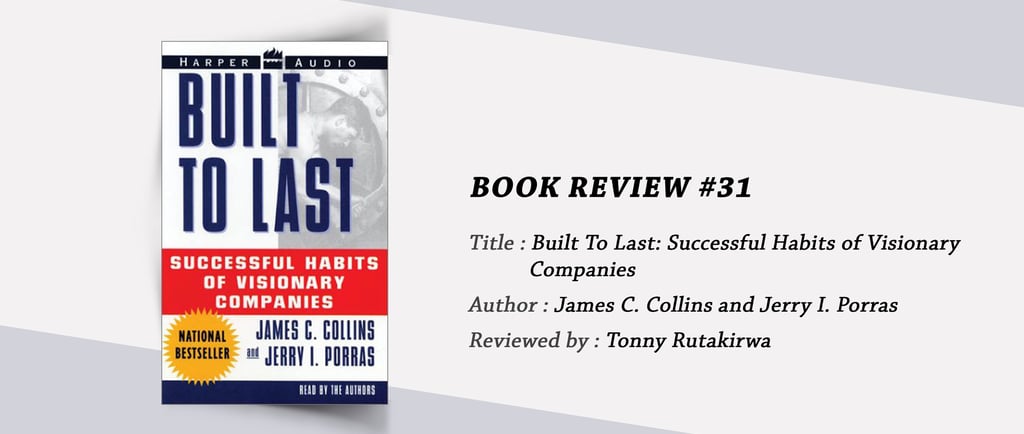
There are numerous genres of books and literature that are written to fill a specific need. Built to last is a management book written by Jim Collins and Jerry Porras in 1994. It is a comparative book showing how 18 companies are successful and comparing them to companies that were less successful in understanding and what sets them apart.
Jim Collins is an excellent researcher, writer, and teacher who graduated from Stanford University with double degrees in business administration and mathematical science. Jerry Porras is an emeritus at Stanford Graduate School of Business and also a lane professor of Organizational Behaviour. They both got together about 26 years ago to write the book “Built to Last.”
Premise Of The Book
As at the point of writing this book, the authors had two major visions which are: to come up with a conceptual framework with common dynamics and characteristics of highly visionary companies as the foundation. Also, they aimed to communicate these concepts effectively to the public so they can be useful to others.
The author wrote, “built to last” as a comparison between large and functional organizations. They compared 18 great performing companies with companies that had a good track record but had not really distinguished themselves. The one element that was seen to distinguish significantly the great from the good companies was the vision the great companies had.
What the Book Is About
The book was written by its authors to find out successful companies who are the best in their various areas and that have been able to survive the various changes that have occurred in their businesses. The book, however, identified 18 companies, Citicorp, Procter and Gamble, Philip Morris, American Express, and 14 other great companies. These companies were said to have persisted for a long time, surviving various drastic changes in the market and changes in leadership.
The book explains the reasons why successful companies can endure challenging situations and last for a long time. Also, it describes how visionary companies have been able to distinguish themselves and what it is that makes them different.
The book classified companies as successful if they can be able to survive various personnel change, product changes, or market change. A great idea is great for starting a business, but what sustains it is defining a process that will work regardless of the concept, product, or personnel.
In this book, it is also seen that companies that are successful all have goals that do not necessarily involve making profits. Money should come as a result of completing the company’s mission. The mission statement should not include making profits.
The author used compelling examples to support the points and concepts brought on in the book, for a company to be successful, it has to have 3 or 4 significant principles. Aside from the core principles, a company should be willing to change anything to ensure the company continues to thrive. Companies start to fail when they refuse to let go of old ideas or refuse to change as time and market demands.
Lessons to Be Learned From This Book
You don’t necessarily need a great idea to start a company. This is because companies turn away from various great ideas just to continue to survive.
For a company to be successful, it must have core ideologies that consist of a higher purpose and a set of core values that the company will never deviate from.
Visionary companies are run like a cult. If you are a new employee, it is either you are in or you are out very quickly. This is as a result of their core ideologies not giving room for compromise, so they go for the best employees with the same mindset.
To Wrap It Up
The book shows why certain organization last longer than others and also outlines what it takes to be a visionary organization. It also incorporated to help understand each of the concepts it was explaining.
It is a good and relevant book to read for investors and for those who are looking a bit outside the typical investment literature. This book has remained relevant over the years.