
Bull: Understanding Financial Cycles | Maggie Mahar | A Book Review
Explore the insights from Maggie Mahar's book on financial cycles, essential for 21st-century investors. This review highlights key concepts and strategies to navigate today's financial landscape. Book review.
BOOK REVIEWSMONTHLY STATEMENTS
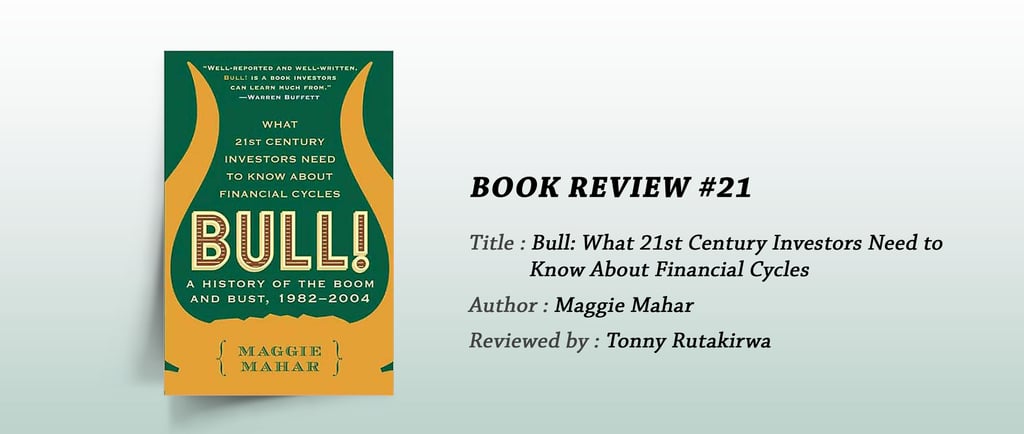
Several historical books, spanning across various cultures and themes, help us not only to understand the past but also to grasp the intricate ways in which those past events shape the present and, most likely, influence future developments. However, there are only a handful of exceptional books that are not only historical in nature but can also moonlight as insightful investment guides or provide astute financial advice to modern readers, making them invaluable additions to one's library.
The year 1982 to 2004 marked a significant period, known for one of the largest bull rallies in the history of America’s stock market—a time that saw fortunes made and lost at a breathtaking pace. Maggie Mahar, a respected financial journalist and a successful author, accurately captures that transformative period in American history through her detailed narrative in her book titled Bull: What 21st-Century Investors Need to Know About Financial Cycles, which serves as both a historical account and a fundamental guide for understanding market dynamics.
Before the onset of 1982, people were more inclined to invest their hard-earned money in safer avenues like bank deposits, gold, or real estate. Indeed, the stock market was met with skepticism by many, resulting in a surprisingly low percentage of the population choosing to invest in market endeavors during that time, largely due to the uncertainty and volatility observed in past market dynamics.
The Dow Jones index had hovered below 1000 for several years, and the market valiantly rose with impressive speed, peaking at 11,000—an astonishing leap that left many analysts and lay investors alike in awe. This remarkable transformation marked the beginning of the bull market that surged forth starting in 1982 and continued its ascent until around 2004, a period that reshaped financial landscapes and investor strategies alike.
What’s The Book All About?
This thoroughly researched book offers an inside look at the remarkable bull market and the intricate 17-year cycle of growth that influenced economic strategies during that time. The narration was woven through a series of in-depth interviews conducted by the author, supplemented by unparalleled access to a diverse array of market observers, financial analysts, hedge fund managers, and those who are eager to provide a comprehensive perspective on the bull market—detailing what transpired and the reasons behind those pivotal moments.
One of the most useful tools to understand how the market operates is undoubtedly history itself. This is because history is fascinatingly bound to repeat itself. Understanding how the market functioned in the past will provide invaluable insight into how the market might operate now, enabling investors to make informed decisions based on historical patterns. That understanding might yield room for significant investment opportunities, potentially leading to greater financial success.
This remarkable piece of financial history, therefore, provides a detailed account and illuminates various aspects of the 1982-2004 markets. Furthermore, it also shares insightful details about individual investors, analysts, financial media, and much more. The author has meticulously compiled a wealth of useful statistics that empower readers to put the bull market into a meaningful perspective, highlighting its impact on various sectors of the economy.
It is quite astounding how an event can appear crystal clear when viewed through the hindsight of retrospect. The amazing bull market that was ignited in 1982 is therefore rendered crystal clear in this book, showcasing how every segment of the market fell into place in a harmonious fashion, contributing to its ascendant trajectory.
Those who do not take the time to learn from the past are often doomed to repeat the same mistakes of their predecessors. Although history might not replicate itself precisely, there is invariably a pattern that emerges from past events. In the epilogue of the book, the author attempts to forecast what might lie ahead in the stock market, starting from late 2003, utilizing the lessons that history provides to inform the predictions of the future and guide potential investors.
The Concept Of The Bull
The bull does not merely symbolize the operations and incentives of the Wall Street players; it extends beyond to sensitize retail investors about crucial cycles inherent in the market. Moreover, it elucidates how the financial cycles operate, the diverse causes behind both the bull and bear markets, and provides an informed analysis of market trends.
This book does not limit itself to teaching solely the history of the stock market. It strives to educate aspiring investors on the intricate inner workings of the stock markets, fostering a deeper understanding that can empower them to make judicious financial decisions. Even more, it keenly analyzes the varied investor behaviors exhibited during each segment of the market cycle and meticulously outlines the similarities and commonalities observed in multiple events throughout market history.
The author taps into the sentiments and thought processes of the investors within that transformative era, bridging the gap between the past and present. Additionally, the book is replete with a plethora of intriguing historical anecdotes alongside a number of compelling financial theories that invite readers to contemplate the cyclical nature of the economy.
To Wrap It Up
Maggie Mahar, despite the book's classification as a financial text, has succeeded in making it accessible and engaging, avoiding overly technical language that might alienate general readers. It is truly an essential read, particularly for individuals who are too young to remember the essence of the great bull market firsthand and are looking to forge ahead in their investment journey.
Understanding the market cycle is indispensable for any serious investor. Therefore, this book is a must-read for anyone interested in navigating the complexities of investing in the stock market. With an unparalleled historical summary of the financial market, encompassing valuable insights and lessons, you certainly need to get your hands on this thought-provoking and informative book.