
Exploring the History of Philosophy | Love of Wisdom
Delve into the rich history of philosophy, a journey through the love of wisdom that has shaped human thought and culture. Discover key philosophers, movements, and ideas that define this fascinating field.
MONTHLY STATEMENTS

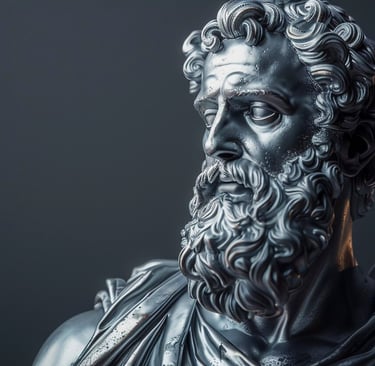
Philosophy –the love of-wisdom- is a pretty complicated subject, and there is no guarantee that you will actually get wisdom. Chances are that you will be lost somewhere in the vast world of –isms and paradigms. This profound topic can often lead one down many different paths of thought, making it difficult to find a singular truth. So let me explain it to you in the easiest and simplest way, and tell you about some of the most significant philosophers of all time, whose thoughts and ideas still resonate with us today and provide deeper insights into our existence.
So basically philosophy is about everything. It is a quest for meaning and better understanding of the world and our place in it. It is also the search for answers to life’s most pressing questions regarding the very existence of the universe, and subsequently, our own existence, our unique purpose, and the nature of our actions, relationships, and their consequences. So, yes, philosophy is pretty much about everything, encompassing every aspect of human thought and experience, challenging us to think critically and reflectively about the concepts we often take for granted.
The history of philosophy starts in 6 BC (Pre-Socratic Philosophy) and is still in the making (20th-century Philosophy). Throughout the ages, philosophers have been striving to comprehend life in all its complexity and contemplate human nature while simultaneously trying to understand the universe itself. No matter how complicated they may sound at times, philosophical studies, theories, and schools of thought have profoundly shaped the world as we know it today, influencing not just personal perspectives, but also cultural and societal structures.
The story of philosophy predominantly starts with the trinity of classic philosophers –Socrates, Plato, and Aristotle. Among them, Aristotle created an incredibly comprehensive system of philosophy that included various disciplines: ethics, aesthetics, politics, metaphysics, and logic. His influence was so monumental that until the 19th century, the world’s idea of logic was largely based on Aristotle’s systems of deductive reasoning, wherein a thesis and an antithesis would infer synthesis or a conclusion. This foundation laid the groundwork for countless philosophical discussions that followed.
Aristotle believed that we cannot control our moral environment. His doctrine implies that we must navigate the waters of ethics and morality with care and consideration. He believed in balance and equilibrium contributing to a well-lived life and flourishing society. In a political context this meant a medium passage between tyranny and democracy, an ideal state fostering an environment of justice and fairness. On an individual level, he asserted that balance was the key to success and happiness. His profound findings and theories laid down an integral part of the study of science and philosophy, providing a lens through which future generations would explore these fields.
The works of German philosopher, Immanuel Kant from the Early Modern Philosophy shifted the paradigm of the world of philosophy and set it on the path towards Modern Philosophy. His contributions were pivotal, as Kant basically endeavored to combine the ideas (the biggest philosophical debates) of 'Empiricism' (the notion that knowledge comes from sensory experience) and 'Rationalism' (the belief that knowledge is rooted in reasoning and lógica). His groundbreaking formulation of ‘Moral Universalism’ asserts that our actions eventually evolve into universal laws, and that we ought to treat others as ends in themselves and never merely as means to an end.
Karl Marx, the most revolutionary philosopher of the 19th century, presented the Marxist theory that incorporates profound ideas and theories of materialism, class struggle, the labour theory, and the ongoing battle between the bourgeoisie against the proliferating Capitalism that defined the 19th-century societal landscape. His works provided the radical foundation for Socialism and Communism, influencing generations of thinkers and activists, and shaping the political discourse ever since.
Final Word
These philosophers are just a few of the most significant names in the expansive world of philosophy. They introduced new concepts, shifted longstanding paradigms, and laid down the foundational bases for future theories and ideas within philosophy. Their thoughts continue to inspire and provoke further inquiry, encouraging us to question our own beliefs and understandings about the nature of reality and our existence.