
The Entrepreneurial Bible to Venture Capital by Andrew Romans | A Book Review
Discover insights from 'The Entrepreneurial Bible to Venture Capital' by Andrew Romans in our detailed book review. Learn how this essential guide can help you navigate the world of venture capital.
MONTHLY STATEMENTSBOOK REVIEWS
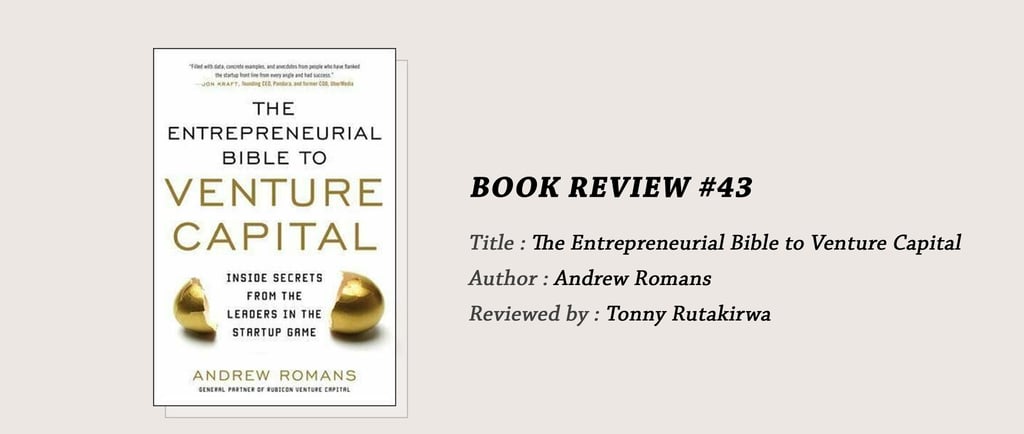
For every start-up entrepreneur or business investor, comprehending Venture Capital (VC) or funding for their innovative ideas is a big challenge. Venture capital firms fund start-ups with budding talent and prospective profits in the future. But is it really easy to get VC? You are here, so this means you already know the answer to that, and perhaps you are curious to delve deeper into the intricacies of this often misunderstood area of business funding.
The Entrepreneurial Bible to Venture Capital by Andrew Romans is the perfect book for every start-up entrepreneur, angel investors, venture capitalists, and VC ecosystem service providers. Andrew Romans brings together 40 best Venture Capitalists and founders in one comprehensive book, ensuring that it serves as a crucial guide for those looking to navigate the complex waters of venture capital.
When reading the book, you will notice that Romans has a systematic perspective on the VC ecosystem. He uses this to form his understanding of every aspect from an innovator's vision to finance, and from legal matters to people capital. This makes the book invaluable for every founder and entrepreneur, as it does not merely skim the surface but delves into the details that can make or break a start-up.
If you are a start-up entrepreneur or a company founder with an innovative idea, The Entrepreneurial Bible to Venture Capital will help you in discovering and devising ways to implement it and formulate a solid company outline. The book shares practical suggestions and explains how venture capital works, unraveling the often complicated jargon associated with the field. Even for Venture Capitalists, the book shares vital practices to help you find and connect with the right founders, ensuring that both parties can mutually benefit from a partnership.
The scope of the book is wide, but at the same time, it does a pretty great job of explaining the venture capital game, ensuring that readers can grasp the fundamentals without feeling overwhelmed. For would-be entrepreneurs, understanding the VC ecosystem is neither exciting nor easy; however, Romans does a remarkable job of simplifying the processes and demystifying the barriers that exist within. Even those who have studied business and entrepreneurship sometimes find it difficult to wrap their heads around the complex VC ecosystem, but with Romans as your guide, these challenges can be addressed systematically.
Lucky for them, The Entrepreneurial Bible to Venture Capital is truly what it claims to be… the Bible for Start-ups! The Entrepreneurial Bible to Venture Capital reveals that venture capital is indeed a game where you need perfect timing, advanced technology, the right team, and your share of good luck to succeed. It highlights the importance of being strategically adept while also emphasizing the unpredictable nature of the start-up landscape.
The book covers every aspect of venture capital that you can think of, painstakingly discussing everything from initial funding to exit strategies. At the same time, it is not too commonplace or clinical; instead, it engages the reader in a conversation that is both informative and enlightening. Andrew Romans starts by narrating a brief history of venture capital, touching upon seminal moments that have shaped the industry, and then one-by-one explores different stages that you will undertake during the journey to secure funding and grow your business.
In the business world, a start-up gives the venture capital firm a share of corporate equity, and this exchange forms the basis for much of the required financial scaffolding. As more start-up companies and entrepreneurs are emerging, the market for VCs is thriving, creating a vibrant ecosystem where innovation and investment meet.
Looking at the history of Venture Capital, Romans says that things were very different three decades ago. In the 1990s, start-up costs were rigid, and new companies had to put together the funding to cover the expenses of everything from servers to software licenses. However, now (2013—when the book was published) things have changed drastically due to technological advancements and shifts in market dynamics. With the increase in technological innovations and advancements, there has been a great reduction in the start-up cost of a new company, allowing for a broader range of entrepreneurs to enter the scene.
For instance, cloud computing has significantly reduced the cost of storage and accessibility. Because of such advancements, it is now possible to launch the beta version of a website or a mobile app with less than $5000, opening doors for many aspiring entrepreneurs. This is where VC firms come into play, as they step in to invest in a start-up business or to lend money to an entrepreneur. However, banks consider a lot of intricate aspects before they approve funding, requiring a sound business plan, a marketable product, and a huge margin for profit to justify the loan.
Comparatively, VC firms are willing to take the risk and provide the needed cost earlier than traditional banks. For a venture capital firm, a lot is at stake; they must carefully weigh the potential rewards against the inherent risks. But at the same time, they know there is also the potential for great profits. So, they bet on future payoffs and lend start-ups the necessary funds to begin their journey into the world of business.
The ‘venture’ of a company, an investor, or an entrepreneur becomes the ‘venture’ for the VC firm too. Risks are higher; almost 60% of start-up companies and entrepreneurs face bankruptcy much before they can start paying off their VC firm. The chances of success are so steep that only 1 out of every 10 investments made by VC firms turn out to be successful! For investors, however, that one successful story could be all they need to validate their approach and investment strategy.
In the later chapters of the book, Andrew Romans digs deep into guiding the VC investors and especially the start-ups about venture capital, highlighting best practices, pitfalls to avoid, and strategies for sustainable growth.
Every venture capital firm builds its partnerships and establishes its business relations based on one fundamental goal, and that is to make a profitable exit. To do this, they evaluate everything thoroughly. Their focus mainly lies on the start-ups with a robust and coordinated management team that demonstrates not just potential but a well-thought-out plan for execution.
To receive more funding from a VC firm, most often, the first step is to land a cash infusion from an angel investor. To attract VC investors, start-ups should look for pioneering methods of growing value and consistently enhancing their offerings. But since no one can deny the uncertainty of the project, a smart start-up should always plan a good exit strategy in order to ensure long-term viability.
Overall, The Entrepreneurial Bible to Venture Capital is full of interesting and insightful information that will be priceless for both VC investors and start-ups. If you are one, hold this 'bible' close to your chest (or head), as it may very well guide you through the complexities of the venture capital labyrinth and lead you towards success.