
Who Moved My Cheese? by Spencer Johnson, M.D. | A Book Review
Discover insights from 'Who Moved My Cheese?' by Spencer Johnson, M.D. in this comprehensive book review. Explore the themes, lessons, and impact of this motivational classic on personal and professional growth.
BOOK REVIEWSMONTHLY STATEMENTS

Books can be a source of vast knowledge and insights into the human experience. Different books teach different things that humans can learn a great deal from due to the diverse perspectives and ideas they present. From self-help books that provide guidance on personal growth to motivational books that inspire action, historical novels that bring the past to life, and many more genres, many of them contain a wealth of knowledge just waiting to be tapped and explored.
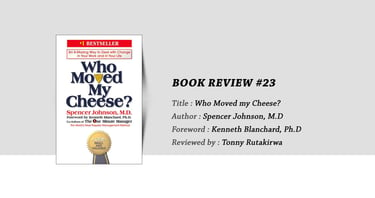
For instance, "Who Moved My Cheese" by Dr. Spencer Johnson, published in 1998, just like every other book, contains valuable insights and particular knowledge that is ready to be read and utilized. Unlike most traditional books, this one uses a short parable format, which effectively illustrates the different ways in which one can respond to the inevitable changes that occur in our lives and environments.
The book elaborates, just like many self-help books do, on how skillfully we respond and handle changes can significantly help us find more success and happiness in our everyday life. It is a thoughtful parable that follows the life of four distinct characters: Sniff, Scurry, Hem, and Haw, as they navigate the twists and turns in a giant maze in search of cheese, which symbolically represents their goals and desires.
Johnson cleverly uses cheese in this book as a metaphor for what you want or desire in your life, such as a good job, a stable relationship, financial security, a cozy home, good health, peace of mind, and so on. The maze in the book also represents the various paths we take as we search for the things we desire in our lives, whether it's the workplace, family, community, friends, or other significant areas of our existence.
The whole book illustrates that no source of cheese lasts forever; changes will inevitably occur whether one likes it or not; it is indeed one of the only constants we can rely on in life. How we survive and thrive is greatly dependent on how well we can adapt to the constant changes that occur at every turn. It is that particular skill of adaptability that will guarantee our happiness, fulfillment, and that we attain what it is we truly desire.
In the parable, the four characters are all faced with unexpected and sometimes daunting changes. In the end, it was the one character who was able to effectively deal with the changes and navigate through the uncertainties successfully. He then went ahead to inspire others by writing what he learned from his experiences on the wall of the maze, sharing his newfound wisdom and insights.
What the Book Teaches
Change in life is inevitable; thus, one should learn to anticipate it, adapt to it, learn from it, and ultimately enjoy it. By practicing these principles regularly, you will be able to suffer less stress and unhappiness; instead, you will enjoy a greater sense of fulfillment and success in every sphere of your life.
We all strive toward a better outcome in our life, work, and relationships, all for the sake of achieving true happiness. Life, however, changes frequently and unexpectedly, which sometimes inhibits us from achieving those things we genuinely desire, causing frustration and disappointment. But because of the fear of starting over or the fear that we might end up worse off, we refuse to change and instead resist the changes that life presents us.
It is only when you come to see the writing on the wall that you will be able to discover your true self and learn how to effectively deal with change. This self-awareness and adaptability will help you enjoy more success and fulfillment in your work and life across various domains.
The Writing on The Wall
Keep in mind that the cheese mentioned in the writing on the wall is a metaphor for the things we truly desire and aspire to achieve in life. The writings on the wall in this book encapsulate important lessons, which are as follows:
• Having "cheese" makes you happy and fulfilled in your pursuits.
• If one does not change, you risk becoming stagnant or even extinct in the face of opportunities.
• Smell the "cheese" as often as possible, so you will know when it becomes stale or no longer serves you.
• Moving in a new direction helps you uncover fresh "cheese" that can enrich your life experiences.
• The faster you rid yourself of the old "cheese," the quicker you will be able to discover new "cheese" that aligns with your growth.
• Identifying and addressing small changes in your life helps prepare you to deal with larger, more significant changes that are likely to come your way.
• Move with the "cheese" and make sure you enjoy the journey as you pursue your goals.
In Conclusion
Who Moved My Cheese revolutionizes how one looks at change, providing powerful insights that can enable one to achieve success even in these rapidly changing times. This book is suitable for readers of all ages and backgrounds, and it is sure to help everyone who takes the time to read and reflect on its message.
The book is simple to read due to its easy language and straightforward narrative. Furthermore, because it is relatively short, it would not take much of your time to complete. If you require success in all facets of your life—be it personal, professional, or relational—then "Who Moved My Cheese" is undoubtedly a book you must read and reflect upon.